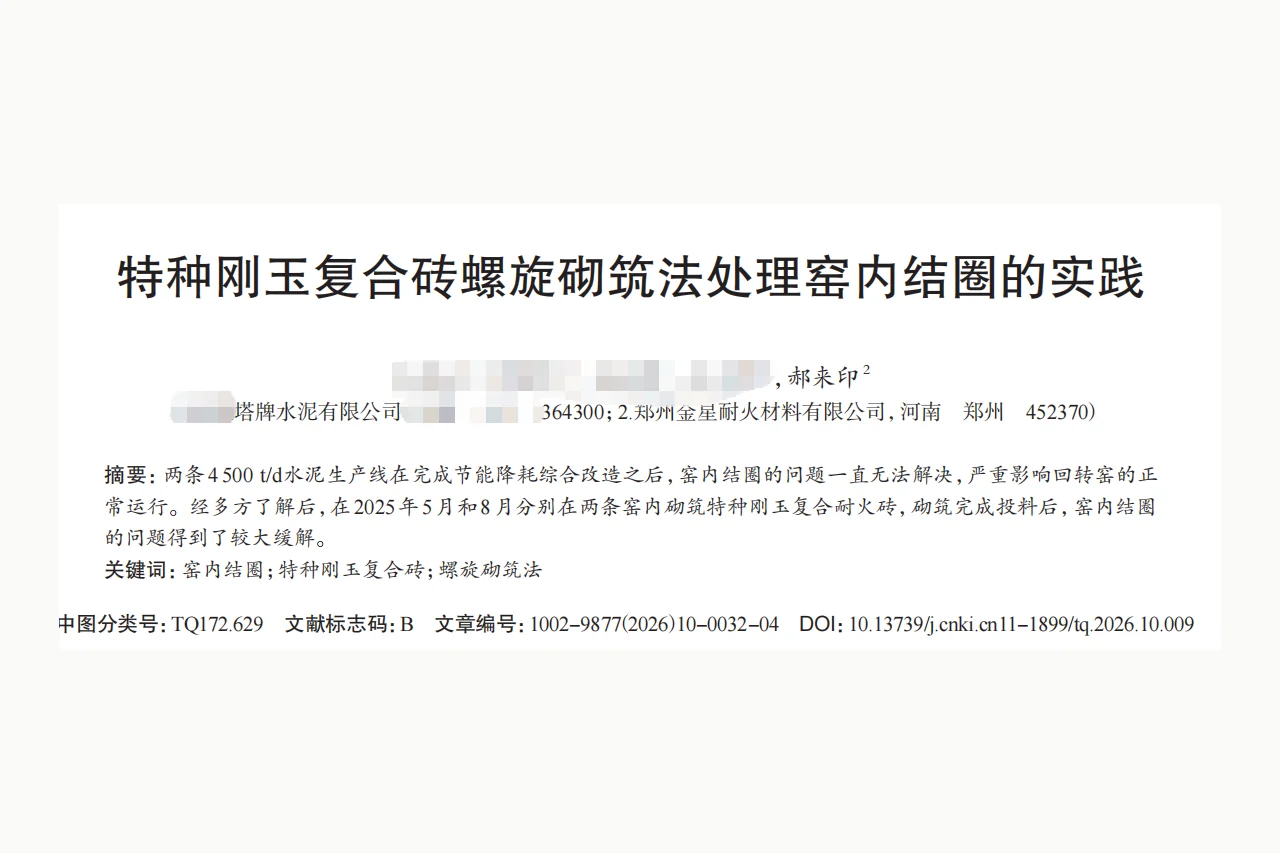
Hao Laiyin of Zhengzhou Jinxing Refractory Co., Ltd. is a co-author of the practice paper “Practice of Treating Kiln Ringing by Spiral Bricklaying of Special Corundum Composite Brick,” published in Cement, Issue 10, 2026. The paper records how Jinxing special corundum composite brick performed in large cement rotary kilns.
Fujian Tapai Cement Co., Ltd. operates two Φ4.8×74 m, 4,500 t/d rotary kilns. After a comprehensive energy-saving retrofit, rings still formed frequently in the 40–50 m zone. With alternative fuels and RDF in use, sulfur-alkali compound rings kept coming back, holding up material flow, reducing kiln ventilation, and clearly disturbing stable operation.
The plant therefore lined the kilns with Jinxing special corundum composite brick. The advantages of this brick are clear: refractoriness under load of 1,700 °C, so the brick keeps its shape and strength at high temperature and resists the scouring of the burden; thermal shock resistance of more than 170 cycles in 1,100 °C water quenching, against only 6–8 cycles for new magnesia-iron spinel and magnesia-alumina spinel bricks; cold crushing strength of 86 MPa after the alkali test, above the 50–70 MPa typical of those spinel bricks; refractoriness above 1,800 °C; and abrasion loss below 3 cm³. These are the properties a transition zone needs when high temperature, thermal cycling and alkali attack arrive together.
The brick was laid in a spiral pattern: high and low bricks were paired with a 30 mm height step, forming a raised spiral band inside the kiln. The burden is lifted and dropped again and again, exchanging heat more fully with the hot gas, which also helps clinker quality. Kiln 1 was lined in the zone at about 40–52 m in May 2025; kiln 2 was lined in the same way in August 2025.
The operating figures after the kilns were put on feed speak for themselves. On kiln 1, feed rose from 360 t/h to 400 t/h, kiln current fell from 980 A to 920 A, and coal consumption fell from 135 kg/t to 133.5 kg/t. On kiln 2, feed rose from 350 t/h to 380 t/h, kiln current fell from 990 A to 750 A, and coal consumption fell from 135 kg/t to 134 kg/t. Ringing on both lines was considerably eased, ventilation improved, and the kilns ran more steadily. After about 12 months on kiln 1 and about 9 months on kiln 2, an in-kiln inspection found the spiral bumps still about 30 mm high, with no spalling and no abnormal wear.
The work delivered three gains: ringing was greatly eased, lining life was longer under alternative fuels, and costs came down. Jinxing special corundum composite brick has shown its value in actual kiln operation. To have the same brick and bricklaying method assessed for your rotary kiln, please send an inquiry.